
Featured Stories
Derby USD 260 teacher helps students see enduring strength of the Declaration of Independence, U.S. Constitution
Jun 25, 2026
by Angela DeinesLaura McFarren knew once she got into education, it would be her lifelong career. She also knew teaching American history and government would continue to be challenging but she would be up to the test of inspiring young people to be engaged, knowledgeable citizens.
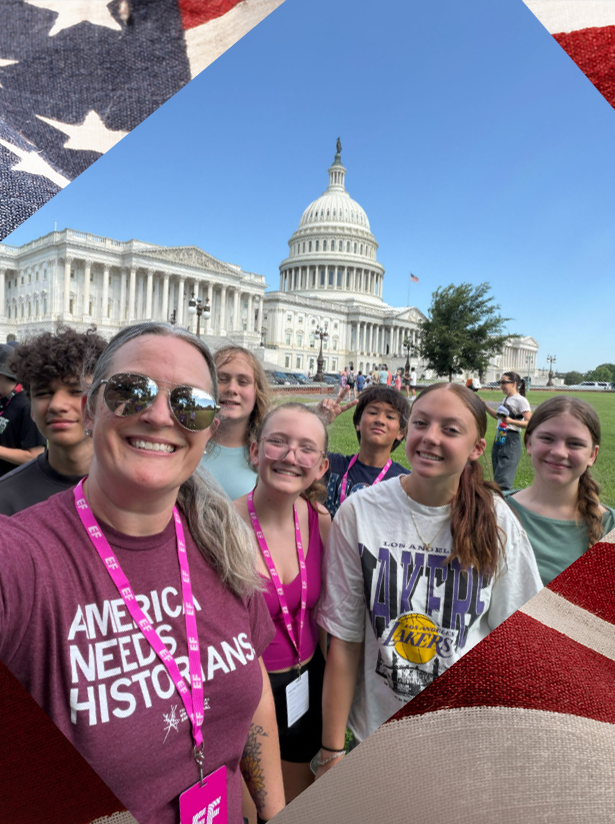
“I want them to vote,” said McFarren, who has taught eighth-grade social studies and history for the past 10 years at Derby North Middle School, Derby USD 260. “I want them to join local boards and get involved. I want them to volunteer to coach little league teams. I want them to be kind and respectful online. All of that begins with the teaching of American history and the founding of our country, rooted in the Declaration of Independence and the Constitution.”
McFarren, a veteran teacher of 22 years, credits her teaching approach to Tim Hallacy, her eighth-grade social studies teacher, when she attended Silver Lake USD 372 schools.
“He had a way of presenting content outside of the textbook and challenging us to think critically about topics,” she said. Her interest in history and politics grew while attending Silver Lake Jr.-Sr. High School, McFarren said, under the coaching of Gail Naylor. Before retiring in 2013, Naylor gained numerous national awards and recognition for her students’ success in speech and debate, including her election to the National Speech & Debate Association Hall of Fame.
At Derby North Middle School, McFarren said she and her grade-level teaching partner, Laura Bowersox, knew this school year and the 250th anniversary of the Declaration of Independence would be a significant one for their content area. She said they set a goal in August to teach civic principles with the intent of redirecting their students back to the ideas that founded the United States.
They started with looking at the different versions of the Declaration of Independence, including how the “all men are created equal” phrase was not in the final draft.
“They see that from the beginning, the ‘paradox of liberty’ will be a complicated undertone to our country’s founding,” she said.
McFarren said as the school year progressed, they also moved forward in time of America’s history, focusing on “the ripple effects in the movements westward, including the establishment and chaos of Kansas becoming a state.”
Moving into the actions preceding the Civil War, McFarren and Bowersox’s students chose certain “trigger events” to research and prepare presentations on, explaining why their event was the most important to spark the four-year war from 1861 to 1865.
McFarren said they worked in pairs using a bracket-style challenge format, showing how slavery was tied to their topic and how their topic was the most significant one on the board. Their classmates would vote on who got to go on to the next round.
“Of all the content we cover in my class, I think this unit sinks in more than any other, mostly because of the repetition,” she said. “They may hear about the secession of southern states multiple times in their class period throughout the week because of the structure of the bracket.”
McFarren said the events leading up to the Civil War showed the struggle to “define liberty and equality for all people living in the United States.” She said her favorite day was when her students examined the Gettysburg Address because of President Abraham’s use of the “all men are created equal” phrase from the Declaration of Independence.
“I asked (my students), ‘how does Lincoln build on the idea of equality from the Declaration of Independence, and why might that matter during the Civil War?’ and ‘why did he choose that phrase at this moment in history?’,” she said. “This is when lightbulbs started to go on around my room. Founding principles we’d been covering the entire school year became real and history started to intertwine.”
McFarren said the school year finished with looking at the Reconstruction Era which lends itself to emphasizing how the U.S. remains a “work in progress.”
“We have times when we get things right and times when things seem to be horribly amiss,” she said. “We just need to keep teaching the Declaration of Independence, Constitution, and the founding principles that have kept us afloat through so many times of difficulty.”
