
Featured Stories
KSDE annual workshops guide districts through school finance, new laws
May 21, 2026
by Angela Deines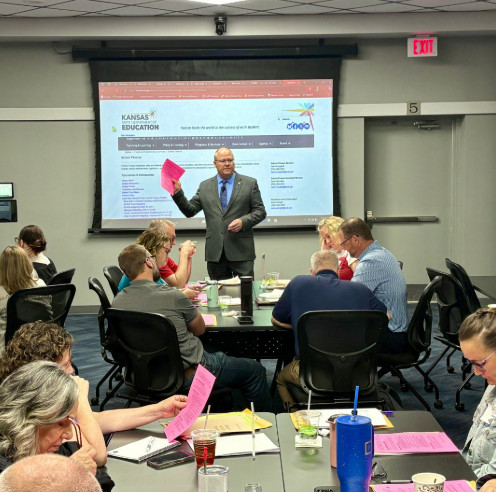
After five years of helping districts prepare their operating budgets, the one constant Dale Brungardt sees is “a lot of good people throughout the state who have a deep care and understanding of the budget.”
“I think they really do take good care of their finances,” said Brungardt, who has served as director of school finance for the Kansas State Department of Education since 2021. “They’re taking care of their students and giving the taxpayers the best bang for their buck.”
Brungardt, along with Dr. Frank Harwood, KSDE deputy commissioner, and Gabrielle Hull, KSDE legislative coordinator, will traverse Kansas in June to host the yearly workshops where district staff will receive the most recent legislative and school finance information as they begin their annual budget processes.
With enrollments declining, special education expenses rising and the Consumer Price Index (CPI-U) raising the base state aid per pupil by only 2.9% to $5,778, Brungardt said districts are facing challenges and decisions they’ll have to make for the 2026-27 school year.
“I think there is always a sense of urgency when they're doing their budgets and the
pressure of knowing what they need to spend,” he said. “But in the school budgeting process, they never know what they get to spend for the school year until June. They're only now finding out how much money they truly have for their district. It'll be tight, but like I said, we’ve got good people working on this and we'll work through it.”
Brungardt said each day of the June workshops will begin with an update from Harwood and Hull on the education-related laws passed during this year’s legislative session. District leaders also will receive information and have the opportunity to ask questions about the new at-risk accountability program, which takes full effect statewide this fall. In addition, the 2026 Legislature restored funding for professional development, mentor teachers, Safe and Secure Schools grants and the National Board certification program.
Brungardt said he expects there also will be a conversation “at some level” about Senate Substitute for Substitute for House Bill 2299, better known as the “cell phone bill.”
“I think the cell phone bill is an unknown for many districts,” he said. “We can only provide so much guidance on that and then districts are going to have to visit with their legal counsel or with the Kansas Association of School Boards as far as how to actually implement that in their policies.”
Depending on the pace and number of questions, Brungardt said the budget process will be discussed in the afternoon, including the 2026-27 budget document that remains mostly the same from the previous year. However, he said there are always minor tweaks that usually are made to the budget document each year, but it will remain largely unchanged.
In the past few years, Brungardt said he has observed more superintendents and other district staff attending the budget workshops who have fewer years of experience in their roles. He said these sessions are vital for them, not only to continue learning the budget process year after year, but they also absorb the knowledge of more seasoned district staff members who attend the workshops.
The New Superintendents Budget 101 workshop on July 7, in Salina, will give those new superintendents or business managers with less experience the chance to be paired up with their veteran colleagues to learn the budget process in an environment that encourages more dialogue.
“It's a much smaller setting and everybody is ‘tied to a rookie’ somehow,” he said.
“That's generally a smaller group that's anywhere from 25 to 45 people. There's a lot of questions during that time.”
Registration is open for the 2026 workshops that begin June 8, in Valley Center, and end June 24, in Topeka. Registration information for new superintendent’s workshop on July 7 will be sent out at a later time.
“We're excited to travel around the state,” Brungardt said. “It’s a lot of work, but we feel it's worthwhile work and we appreciate what districts do as well. We’re ready to go.”
