
Featured Stories
Teacher Appreciation Week: Honoring Kansas Educators Who Champion Students with Unique Abilities
May 6, 2026
by Angela DeinesAs Teacher Appreciation Week concludes on May 8, two Kansas educators share why they chose their special education paths.
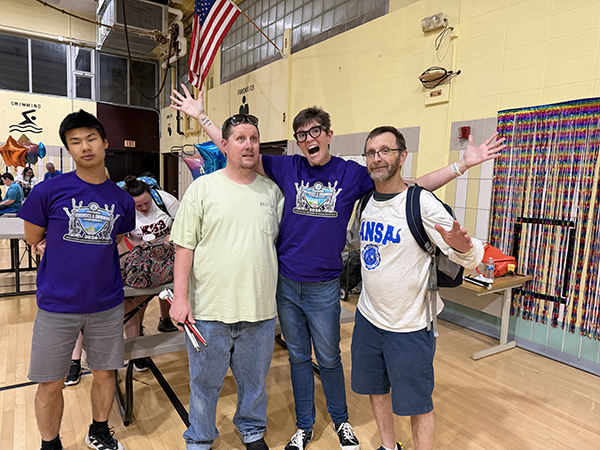
Tim Schierbeck, Kansas State School for the Blind
The three decades Tim Schierbeck has served as a special education teacher and coach at the Kansas State School for the Blind (KSSB) have “flown by” and he’s grateful for the students and staff who are like family at the Kansas City, Kansas, school.
“The students have provided me with memories and laughter for a lifetime,” he said. “The staff at KSSB have always been supportive and I could not have asked for a better place to work.”
With a list “too long to name everyone” of mentors and others who have helped him throughout his career, Schierbeck, a native of Havana, Illinois, began working as a paraprofessional at Lawrence High School while attending the University of Kansas. After completing his bachelor’s degree and master’s in special education at KU, he supervised group homes in Overland Park. It was there he met a KSSB staff member who encouraged him to apply for a job at KSSB and was then hired.
As a Certified Teacher of the Visually Impaired (TVI), Schierbeck works with 18 to 21-year-old students in PROJECT Search, a transition-to-work program that is business-led, one academic year employment preparation program that takes place entirely at the workplace.
“I enjoy Project SEARCH as it allows the interns - students are called “interns” - to get a chance to see what it is like to be in a real workplace, dealing with adults in a non-school setting,” he said. “It’s an opportunity for them to learn valuable vocational skills and learn important social skills they will need as adults in an adult setting.”
While he enjoys seeing the older students learn new skills, Schierbeck said he himself is also learning to stay ahead of the ever-evolving technology for students with visual impairments.
“When I first started teaching, IEPs were written by hand. Students with visual impairments learned Braille,” he said. “I have to spend extra time every year learning new technology for the Blind and Visually Impaired, but it’s an important tool that can’t be ignored.”
Schierbeck’s work with visually impaired students has included serving as KSSB’s athletic director for the past 25 years and coaching track, wrestling and goalball.
“Ron Hawthorne, one of my former wrestlers, has gone on to become a Paralympian, winning medals in judo, traveling the world and becoming a mentor for other young, blind athletes,” he said.
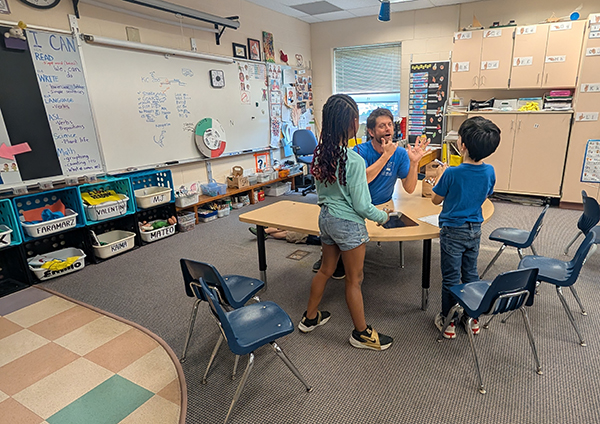
Paul Ososki, Kansas School for the Deaf
After spending most of his childhood in Port Huron, in the “thumb” region of Michigan, Paul Ososki’s early experiences with communication as a Deaf person shaped his life’s learning and teaching path.
“Sign language was not used in my family, and I primarily relied on hearing aids and spoken English,” he said. “It wasn’t until first grade, when I joined a different Deaf and Hard of Hearing program that used sign language, that I began learning sign language.”
Ososki said when he was 13, his younger sister was born Deaf. It was then he said he “felt a strong sense of responsibility” to be a role model for her.
“Teaching her sign language and helping her navigate communication strengthened my passion for Deaf education,” he said.
Ososki said he earned a master’s degree in Deaf Education from Gallaudet University and spent seven years in Washington, D.C., before moving to Kansas in 2012 where he began his “incredibly rewarding” journey as a kindergarten teacher at the Kansas School for the Deaf, in Olathe.
“Young learners are naturally curious and easy to motivate,” he said. “Their smiles are big, their laughter is contagious, and their growth is remarkable. I have the privilege of witnessing and supporting their earliest milestones in language, literacy, math, and social development.”
The challenges of teaching young Deaf children, Ososki said, revolve generally around delays in language and cognitive development, and wide range of their American Sign Language (ASL) and communication abilities. To address those challenges, he said he uses his artistic skills, animated facial expressions, and “a willingness to act in fun and often silly ways that capture their attention and make learning memorable.”
“I strive to create a classroom where students feel seen, understood, and capable,” Ososki said. “Watching them grow in confidence, overcome their frustrations and communicate reminds me why I chose this path.”
One of Ososki’s closest mentors throughout his Deaf education journey is Jean Berube, a long-time Gallaudet University professor and former director of the Deaf school’s Personal Discovery program. He said Berube helped “deepen my understanding of how to connect with people across diverse communities.”
“She also helped me develop patience, the ability to truly listen, and the importance of asking thoughtful questions that go beyond surface-level responses,” Ososki said. “Those lessons continue to shape how I interact with my students, colleagues, and families today.”
